Metal Cladding Over Wood Substrates: What Millwork Companies Need to Know
Metal cladding millwork has become a defining feature of high-end residential, hospitality, retail, and commercial interiors. Stainless steel, brass, bronze, aluminum, and other architectural metals can transform relatively conventional millwork into something highly refined.
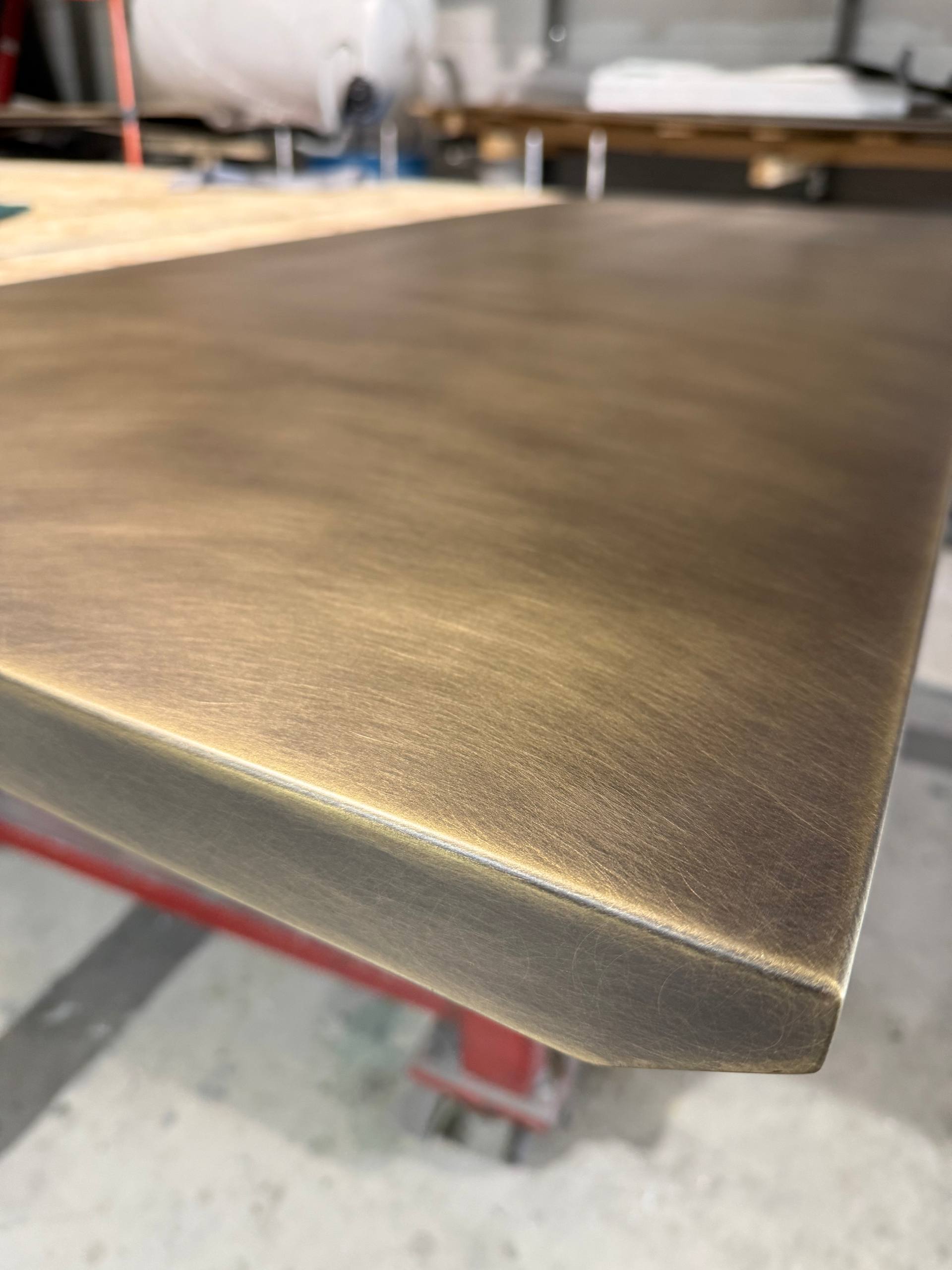
But the finished metal surface is only part of the assembly.
Behind many metal-clad doors, panels, cabinets, columns, and architectural details is a wood-based substrate — typically MDF, plywood, or another engineered panel. And the relationship between that substrate and the metal skin can determine whether the finished piece looks clean and precise or develops problems during fabrication, installation, or use.
For millwork companies working with an architectural metal fabricator, understanding this relationship can prevent expensive remakes, coordination problems, and installation surprises.
Here are the key things to consider.
1. The Substrate Is Part of the Finished Metalwork
Once a wood panel is clad in metal, it may look like a metal component. Structurally, however, the substrate remains a critical part of the assembly.
The metal skin can reproduce imperfections underneath it.
A substrate that is warped, damaged, inconsistent in thickness, poorly machined, or out of square can affect the finished metal surface. With thin architectural sheet metal — particularly smooth or reflective finishes — small irregularities may become surprisingly visible.
Therefore, millworkers and metal fabricators should treat substrate quality as a core part of the finished assembly.
Industry standards also recognize the importance of panel construction and stability. The Architectural Woodwork Institute addresses panel cores, surfaces, balanced construction, moisture content, warping, and other factors that affect architectural woodwork performance.
For metal-clad millwork, those fundamentals become even more important because the finished metal surface often makes imperfections easier to see.
2. MDF vs. Plywood: Which Substrate Is Better?
There is no universal answer. The right substrate depends on the component, dimensions, hardware, environment, fabrication method, and design intent.
MDF provides a flat, consistent surface and clean machining, making it useful for many interior metal-cladding applications. Its limitations include edge strength, moisture exposure, weight, and fastening requirements.
By contrast, plywood may work better where greater structural strength, screw holding, or reduced weight is important. However, its face must be sufficiently smooth: voids, damaged veneers, uneven surfaces, or panel distortion can affect the finished metal.
The important point is simple:
Choose the substrate as part of the complete assembly — not independently from the metal cladding.
3. Flatness Matters More Than Many People Expect
Architectural metal can be unforgiving. A painted panel may hide small imperfections; smooth stainless steel, brass, or bronze may emphasize them. Surface waves, high spots, substrate joints, uneven adhesive coverage, and edge inconsistencies can become visible, especially with reflective finishes.
A metal-clad panel should therefore be treated as a complete assembly rather than simply a wood panel with decorative metal attached.

4. Adhesive Selection Matters
The adhesive layer is invisible, but it plays a major role in performance. Metal and wood-based materials react differently to temperature and humidity, so the bonding system must suit the specific metal, substrate, panel size, environment, and surface preparation.
Not every woodworking adhesive is appropriate for architectural sheet metal. Therefore, fabricators should follow the adhesive manufacturer’s specifications for cleaning, abrasion, priming, coverage, pressure, and curing for the specific materials they bond.
5. Metal and Wood Move Differently
Metal expands and contracts with temperature, while wood-based products also respond to moisture. On large panels, tall doors, or long cabinet runs, this differential movement can create stress between the metal skin, adhesive, and substrate, potentially leading to delamination, edge lifting, bowing, or surface distortion.
The larger the component, the more important it is to consider the assembly as a system.
6. Edge Returns Need to Be Designed Before the Substrate Is Made
A common coordination problem occurs when a millworker fabricates the wood substrate first and considers the metal cladding afterward.
This can create dimensional problems.
If metal wraps around an edge, the finished dimension is no longer exactly the same as the original wood dimension.
The assembly may include:
wood substrate + adhesive + metal thickness + bends/returns + fabrication tolerance
That difference may be small, but custom millwork often depends on very small reveals.
For example, consider two adjacent cabinet doors with a narrow specified gap. If the millworker manufactures both substrates to the nominal finished dimensions without accounting for the metal wrapping the edges, the final reveal can change.
Likewise, the same issue occurs around drawer fronts, integrated pulls, end panels, appliance openings, stone interfaces, frames, and adjacent millwork. The millworker and metal fabricator should coordinate these dimensions before fabrication begins.
7. Corners Are Where Good Metalwork Becomes Obvious
The center of a metal-clad panel is usually the easy part.
Edges and corners reveal the quality of the fabrication.
Depending on the design, corners may require folded returns, welded corners, or mechanically joined edges. Each approach affects appearance, finished dimensions, corner radius, finish consistency, and cost.
This becomes particularly important with directional finishes.
A brushed stainless steel panel, for example, has a visible grain direction. When multiple faces meet at a corner, the orientation of that grain needs to be intentional.
The same principle applies to patinated brass, bronze, blackened steel, and other hand-finished metals where adjacent surfaces need to visually relate to one another.
8. Integrated Pulls Change the Door Detail
Integrated metal pulls create a clean appearance but require close coordination. A folded edge can function as the finish, door edge, finger pull, and structural return at the same time.
Metal thickness, bend radius, pull depth, hardware position, and final reveals must all work together. Therefore, the project team should resolve these details before substrates arrive at the metal fabrication shop.

9. Large Doors Require Special Attention
A cabinet door and a 10-foot architectural door are not simply different sizes of the same detail. As dimensions increase, weight, rigidity, flatness, hinge capacity, bowing, handling, and finished clearances become more important.
Therefore, select hardware based on the finished clad door, not just the wood substrate.
10. Who Should Provide the Wood Substrate?
The millwork company may provide the substrate, maintaining control over cabinet construction, hardware machining, and door dimensions. On other projects, the metal fabricator may provide the complete assembly, simplifying responsibility for final dimensions and construction.
However, neither approach is automatically better. What matters is establishing responsibility before fabrication.
Questions that should be answered include:
- ✔ Who supplies the substrate?
- ✔ Who determines substrate dimensions?
- ✔ Who accounts for metal thickness?
- ✔ Who machines for hardware?
- ✔ Who is responsible for final door dimensions?
- ✔ Who confirms field measurements?
- ✔ Who approves edge and corner details?
As a result, unclear responsibilities make mistakes much more likely.
11. Shop Drawings Should Show More Than the Front Elevation
A front elevation can show what the finished project should look like.
However, it usually cannot explain how the fabricator should build it.
For metal-clad millwork, shop drawings should identify finished and substrate dimensions, metal type and thickness, finish direction, edge returns, corner construction, integrated pulls, reveals, hardware interfaces, adjacent materials, and critical field dimensions.
Sections and detail drawings are often more valuable to the fabricator than elevations alone.
Therefore, resolving a small detail on paper can prevent a very expensive problem in the shop.
12. Finish Samples and Mockups Can Save Money
Terms such as brushed, satin, antique brass, blackened steel, or bronze finish do not always define one identical appearance, particularly with hand-applied finishes. Therefore, the project team should approve physical samples before production when appearance is critical.
In addition, complex details may deserve a mockup. Integrated pulls, unusual returns, tight reveals, welded corners, and metal-to-stone or metal-to-wood transitions are much cheaper to test once than to remake across an entire project.
13. The Best Results Come From Early Coordination
Many problems in custom metal millwork are really coordination problems: insufficient space for a return, metal thickness omitted from finished dimensions, a pull conflicting with cabinet construction, or hardware selected without considering the finished door weight.
Consequently, every solution becomes more expensive once fabrication starts.
Instead, bring the metal fabricator into the process earlier. The team can then resolve these issues while they are still lines on a drawing rather than finished pieces in a shop.
So, metal cladding over wood substrates looks simple once installed. However, successful execution requires substrate selection, metal thickness, adhesive, edge construction, finish, hardware, tolerances, and installation conditions to work together.
For millwork companies, the goal is not simply finding a fabricator capable of producing the metal. It is working with one who understands how that metal integrates with the millwork around it.
At MNR Custom Metal, we work with millwork companies, designers, architects, and contractors to fabricate custom architectural metal components for high-end interiors. From stainless steel and aluminum to brass, bronze, and specialty finishes, our focus is on resolving the details before they become problems in production.
Ultimately, if your next project includes metal-clad doors, panels, cabinetry, integrated pulls, or custom architectural metalwork, early coordination can make the difference between a detail that simply looks good in a rendering and one that works in the real world.
See more
- The Difference Between Mass-Produced and Truly Custom Metalwork
- Metal Railings and Guards: Balancing Safety, Style, and Code Compliance
- The Hidden Difference Between Architectural Metal Fabrication and General Metalwork
- From Vision to Reality: The Process of Creating High-End Architectural Metal Features
- Lead Times in Custom Metal: What Actually Delays Your Project (And How to Avoid It)
- Why Long Architectural Metal Pieces Need Planned Joint Locations